


 Join our
Health Bulletin - July 2025
Optimizing Your Health
Span: A Muscle-centric
Approach
We all experienced first-hand what slowing down means from a physical standpoint. If you watch children playing and doing their normal physical activities, it's amazing how coordinated and well balanced all their movements are without them paying any attention to their form or function. It comes to them so naturally! This is the skill that we all start to lose as we age. This is because our muscles start to age along with our biological clock. This is called SARCOPENIA.
It happens universally in all of us, typically starting at age 35-40. Let's first delve into some basics about muscles in our body.
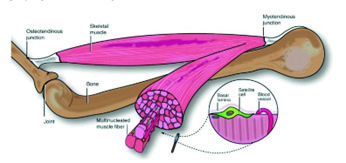
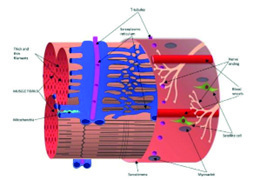
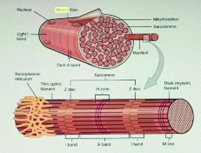
Our body has two kinds of muscles in general - Voluntary and Involuntary. The muscles that move us are called Voluntary muscles or Skeletal muscles. Involuntary muscles are cardiac muscles and there are small smooth muscles that line our blood vessels and intestines.
Skeletal muscles, being under our voluntary control, give us the opportunity to optimize our health span and longevity by providing a good fertilizer - Exercise!
Exercise is the single most important intervention that can decrease your risk of various chronic diseases.
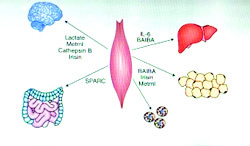
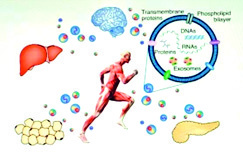
After a meal, 80% of glucose gets tucked away in skeletal muscle. The risk of getting diabetes hence is very low in those with adequate muscle mass. Muscle is also a powerful endocrine organ that secretes several hormones and chemicals during exercise that travel to various parts of the body and improves the function of other organs including our brain health.
These chemicals are called “Exerkines” and are involved in inter-organ crosstalk to decrease inflammation and promote longevity.
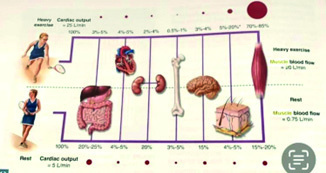
First let's look at a few statistics about our muscles: 30-50% of our total body weight is muscle.
If you are a young healthy man, that muscle mass can be around 35-50 Kg (77-110 lbs). Whereas, in elderly woman, that muscle mass can be around 13 Kgs (29 lbs).
That young healthy person spends 485 calories just at rest because of that muscle mass, compared to 120 calories in the elderly person. This is called the resting energy expenditure (REE). That's a difference of 365 calories in REE.
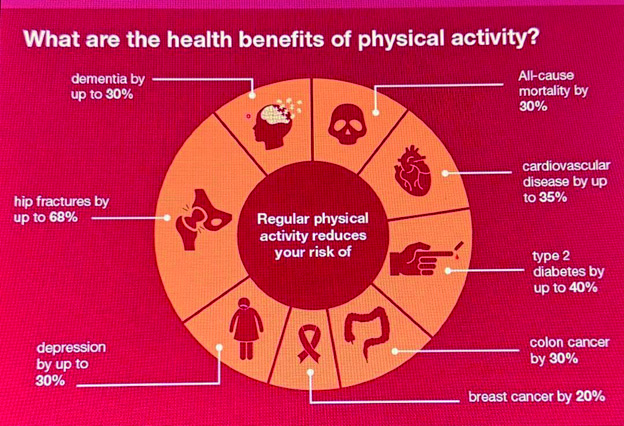
The more REE, the better it is for our overall health and metabolism. So having more muscle mass is the most important factor influencing our life span and Health span.
Sarcopenia is a condition where we start to lose muscle mass starting in our 40's, it is inevitable and a part of aging.
At 40's - 0.5% muscle loss per year
At 50's - 1-2% muscle loss per year
At 60's and thereafter - 3% muscle loss per year
Along with losing muscle mass (Sarcopenia) there's a decline in muscle power (Powerpenia) and decline in muscle strength (Dynapenia) about 1-3% per year starting in 40's as well.
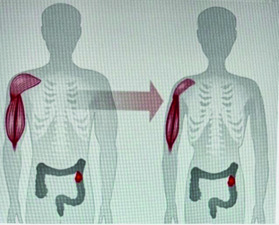
But you can slow down the rate of decline by exercise, especially resistance training 2-3 times a week. It doesn't have to be high load lifting exercises. Resistance exercises with low load provides similar and comparable benefits as high load exercises.
Low load exercises mean using loads that are 30-50% of your one Repetition maximum (ORM). For example, if you take a 20-pound dumbbell and can only do one repetition with your biceps curl, then 20 pounds is your ORM for that exercise. Calculate your ORM for each exercise and then start with Low load resistance training (LLRT) at 30-50% of your ORM.
Doing repetitions to the point of fatigue in that exercising muscle is crucial for obtaining all the necessary adaptations equal to that of high load exercises.
Can combine High load resistance exercises intermittently with Low load resistance exercise session depending on individual capabilities and strength goals.
There are several advantages of Low load exercises such as, low risk of injury, less intimidation to lifting heavy weights in a gym, ease of access to lighter weights such as dumbbells, rather than a membership at a gym, better adherence to exercise routine and can be embraced by people at all levels of fitness with no need for supervision from a trainer.
When it comes to exercise habits, most people embrace aerobic exercises such as walking, jogging, running, bicycling, etc., but less than 10% of people include resistance training in their routine.
There is extensive evidence in exercise research that resistance training provides equal or better health benefits compared to aerobic exercises.
In people with metabolic syndrome such as Obesity, Diabetes, in people with cardiovascular disease, osteoarthritis, mobility problems, or those recovering from illness or surgery and are at low levels of fitness, research has shown that Low load resistance training (LLRT) provides superior benefits compared to aerobic exercises and high load exercises training.
Recent evidence also revealed that Low load resistance training had less adverse consequences than aerobic exercises in patients with established cardiovascular disease.
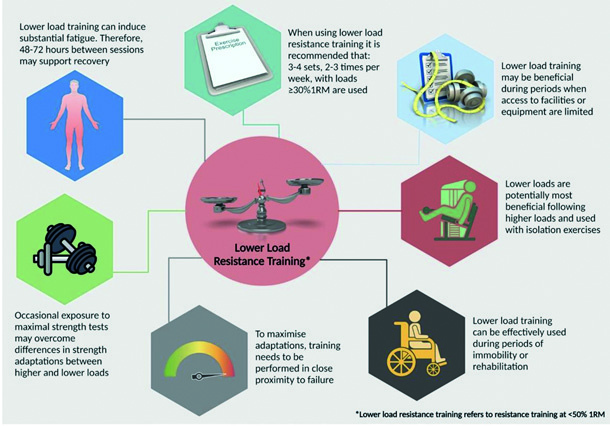
Do LLRT exercises involving most major muscles in your arms and legs 2-3 times a week, with each exercise set repeated 4 times per session. Each set is typically 20-25 repetitions or to the point of fatigue in that muscle.
Having optimal muscle mass and strength regardless of how old one is, can be a most accurate marker of how long they are going to live. A recent study showed that people who can do Sit to raise independently from the floor without external support have 4 times less mortality risk than those who were unable to do this SRT maneuver or required external support to complete the task.



















 info@ataworld.org
